Testing the Case for a Small Bitcoin Allocation With Historical Data
During the last Bitcoin bull market, I wrote Why I’m Not a Bitcoin Maximalist, arguing against putting an entire portfolio in BTC. The short version was: Bitcoin could be a very good asset, but going all-in still does not make sense for most people. The volatility is brutal, the historical sample is short, and short-term losses can be disproportionate. Now U.S. stocks are near all-time highs, most of the euphoria is directed toward AI, and Bitcoin is going through a rougher stretch. That makes this a better moment to make the counterpoint.
I still do not think most people should go all-in on Bitcoin. But I do think many stock-heavy investors, especially younger investors with long time horizons, should consider a small BTC allocation. My TL;DR: almost any stock-heavy investor could justify 2% Bitcoin. My personal comfort zone is closer to 5%. The historical data can defend something like 10% or even 20%, but at that point you are making a much stronger volatility bet.
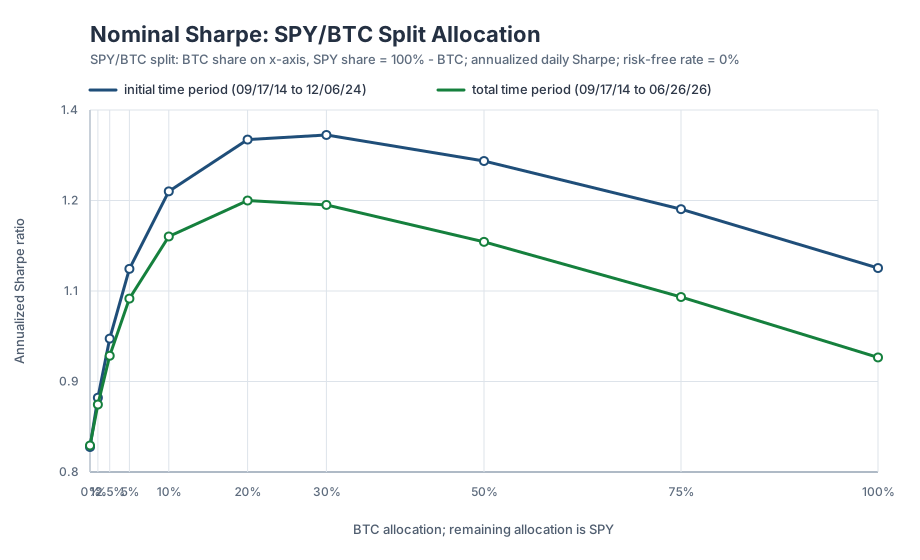
The chart below is the core reason. The first few percentage points of Bitcoin exposure improved the historical risk-adjusted return of a SPY-heavy portfolio. The improvement was not linear forever, which is exactly the point: this is an argument for a small allocation, not Bitcoin maximalism.
I also updated the analysis from my previous article and vibe-coded a small project to reproduce the charts. Methodology and data notes are in the appendix. Code and data: btc-portfolio-allocation-analysis.
Biases first
Historical returns do not guarantee future returns. That sentence is overused, but it matters here. Bitcoin’s public price history is short compared with the U.S. stock market, and any BTC analysis has survival bias baked in because we are analyzing the crypto asset that survived and became culturally important. The graveyard of failed crypto assets is not in the chart. I vouch for no other crypto asset here; BTC is the original crypto asset and the only one I am treating as a serious portfolio candidate.
That said, historical returns are still the main data point we have. The right answer is not to ignore them. The right answer is to use them carefully and stay honest about what they cannot prove.
There are a few other biases in this analysis:
- I am comparing Bitcoin mostly against SPY.
- I am not analyzing individual stocks like NVIDIA. I usually do not trust my ability to pick individual stocks and emotionally handle that volatility.
- I am not treating bonds as a core investment in this article. Bonds can absolutely be good investments for people who want cash flow, lower volatility, or a different risk profile. That is just not the question I am trying to answer here.
- I am using nominal returns. CPI-adjusted returns are intentionally outside this first version.
- I compare an initial sample ending around my previous article with a total sample ending in June 2026. The point is to show how unstable some metrics can be when the market regime changes. A narrator can often pick time horizons that fit whatever story they want to tell.
The last point is important. During a bull market it is easy to find charts that make Bitcoin look inevitable. During a bear market it is much harder. Both temptations are dangerous.
My basic Bitcoin thesis
My fundamental view of Bitcoin is not that number always goes up.
My view is that Bitcoin’s core value proposition is a censorship-resistant way to move value. From that, and from free markets, it can also behave like a store of value.
Even critics of Bitcoin usually acknowledge the basic design: it is a digital asset that can be transferred without a central issuer. The European Central Bank has written much more skeptical material than I would write, but even their Bitcoin explainer starts from that basic fact: Bitcoin is a digital token that can be exchanged electronically, while they dispute whether it works well as money.
This matters because it gives Bitcoin a floor that is not purely narrative. As long as people somewhere in the world find censorship-resistant settlement useful, I do not think the price goes to zero.
That does not mean the price cannot fall 70%. It obviously can. It has done that more than once, just to make sure everyone was awake.
Bitcoin is also deflationary by construction. Over a long enough time frame, that gives it a plausible argument for keeping up with inflation. But I would be careful here. Over periods shorter than one full cycle, say less than four years, Bitcoin can behave nothing like an inflation hedge. Gold is much more stable for that job.
So the assumptions I am leaning on are:
- Bitcoin continues to be useful as a censorship-resistant settlement network.
- Its fixed supply matters over long horizons.
- Short-term price behavior can still be horrible.
I am not making a crypto basket argument
One thing I want to say upfront: this is not an argument for buying every cryptocurrency.
I do not currently support ETH, XRP, or other shitcoins as core portfolio investments. That is partly a moral claim, and partly a portfolio claim; below I am backing the portfolio part with data.
Every crypto bull market gives alternative cryptocurrencies a new breath of attention. The marketing changes, the slogans change, and the screenshots get shinier. But historically, a lot of these assets seem to be correlated with Bitcoin on both the upside and downside, while also suffering worse drawdowns.
That is a pretty bad combination. If an asset falls when Bitcoin falls, rises mainly when Bitcoin rises, and still gives you worse risk-adjusted returns, I need a very strong reason to hold it.
I am not fully proving that point in this article. But let’s look at some data.
Are Bitcoin and stocks still uncorrelated?
The first thing I wanted to check was correlation.
Bitcoin used to be considered an uncorrelated asset. That was one of the cleaner portfolio arguments: even if you were unsure about BTC’s expected return, it might still help a portfolio because it moved differently from stocks.
The newer data is more mixed.
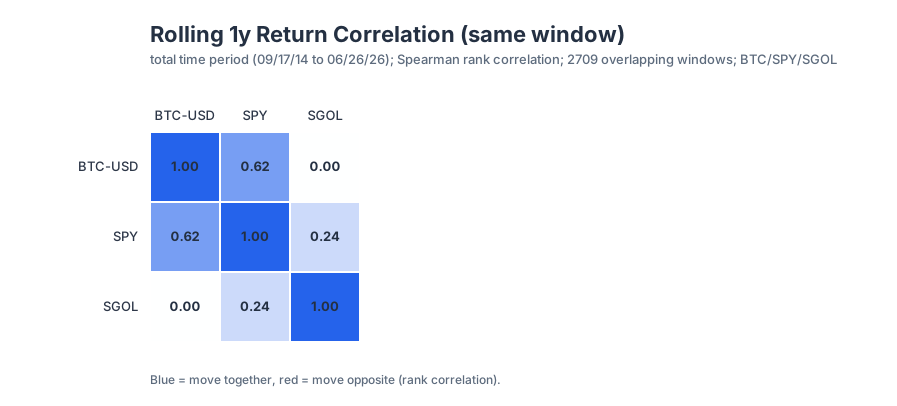
Using the longer BTC/SPY/gold sample back to 2014, Bitcoin’s 1-year rolling rank correlation with SPY is about 0.62. Its correlation with gold is basically zero.
When I include ETH and XRP, the sample starts later because those assets do not have the same history. In that shorter five-asset sample, BTC is more correlated with ETH than with SPY, but the BTC/SPY relationship is still strong. For the total sample, the 1-year BTC/SPY rank correlation is about 0.78, while BTC/ETH is about 0.83.
So BTC actually is correlated with SPY.
Gold still looks like the better diversifier and store of value. Bitcoin looks more like a high-upside risk asset that sometimes diversifies, but not reliably.
The case for Bitcoin is not “it always protects you when stocks fall.” The case is “a small allocation may improve long-term portfolio outcomes enough to justify the extra volatility.”
A conditional matrix is more useful than one correlation number
Correlation is useful, but it can be too abstract. It compresses a lot of market behavior into one number, which is convenient, but also a little suspicious.
So I also looked at this as a conditional matrix. The rows are Bitcoin monthly return buckets. The columns show the average monthly return of BTC, ETH, XRP, SPY, and gold during those same months.
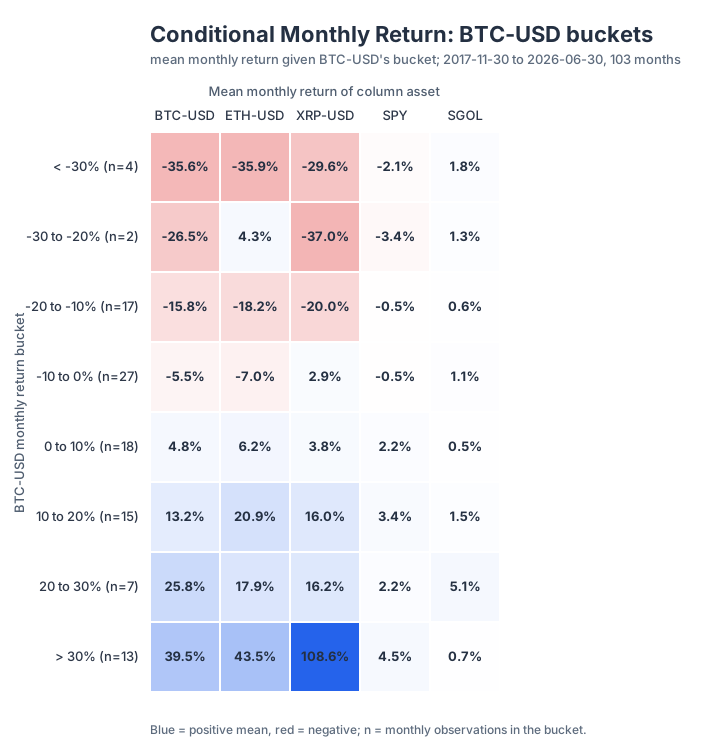
This is a better way to see the crypto relationship than a single correlation number.
When BTC was down between 20% and 10% in a month, ETH averaged about -18% and XRP averaged about -20%. When BTC was up between 10% and 20%, ETH averaged about +21% and XRP averaged about +16%.
In other words, ETH and XRP do not look like clean diversifiers here. They mostly look like higher-beta crypto exposure.
SPY and gold look very different. In the same Bitcoin-down buckets, SPY moved only a little and gold was often close to flat or slightly positive. That does not mean gold will always protect you, but it does suggest gold is doing a different job from ETH and XRP.
The caveat is that the monthly sample is small. The most extreme BTC buckets have only a few observations. So I would not overfit the exact numbers. The pattern matters more than the individual cells: crypto clusters together, while stocks and gold behave differently.
The long-term pessimistic test
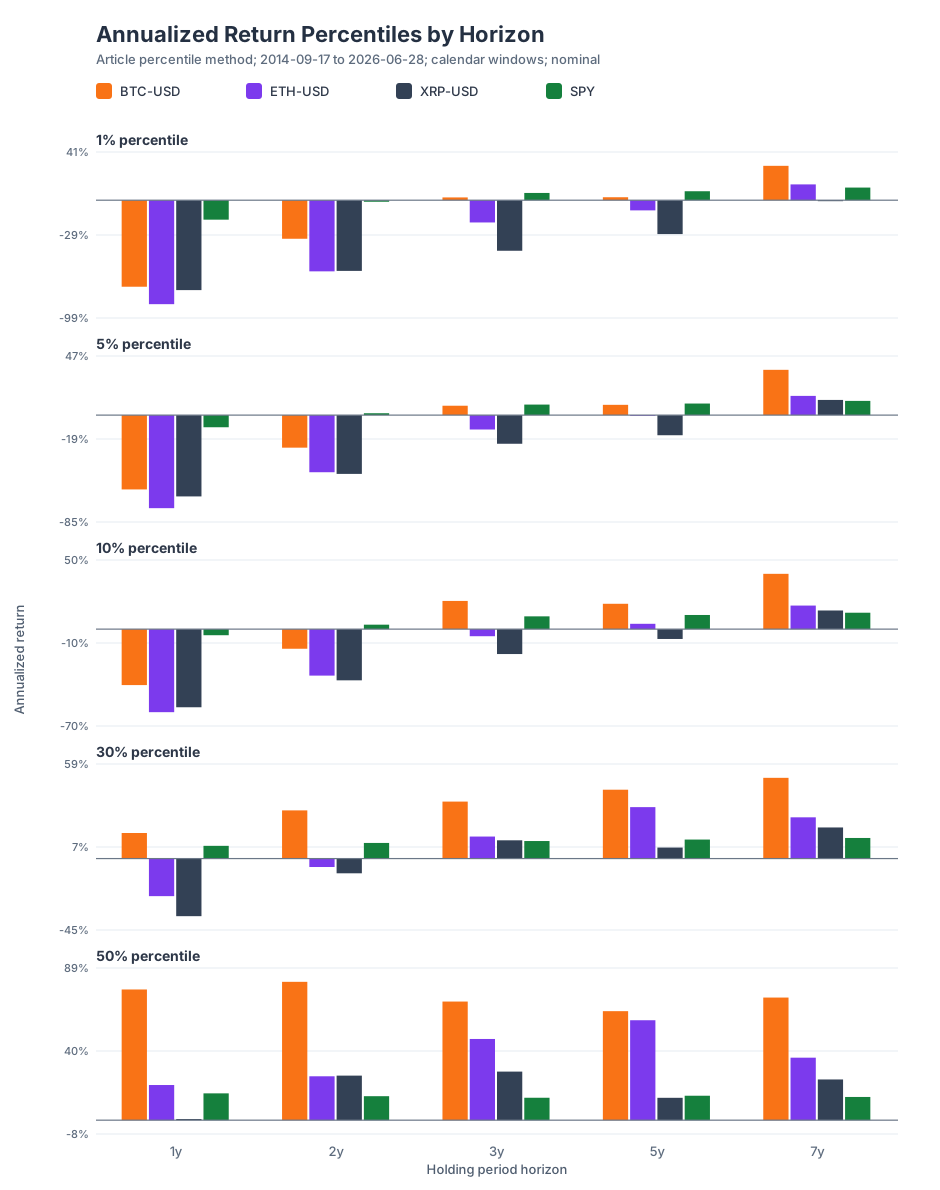
Now let’s do the same kind of pessimistic analysis I used in the older article.
Instead of looking only at average returns, I looked at low percentiles of rolling historical returns. The intuition is simple:
If even the bad historical windows were acceptable, the asset may be less risky over that time horizon than it feels day to day.
The logical trap is also obvious:
Historical bad windows may not include the future bad window.
With that caveat, the data is still interesting. I like starting with the median plus historical percentile bands because it shows both the central case and the ugly side of the distribution.
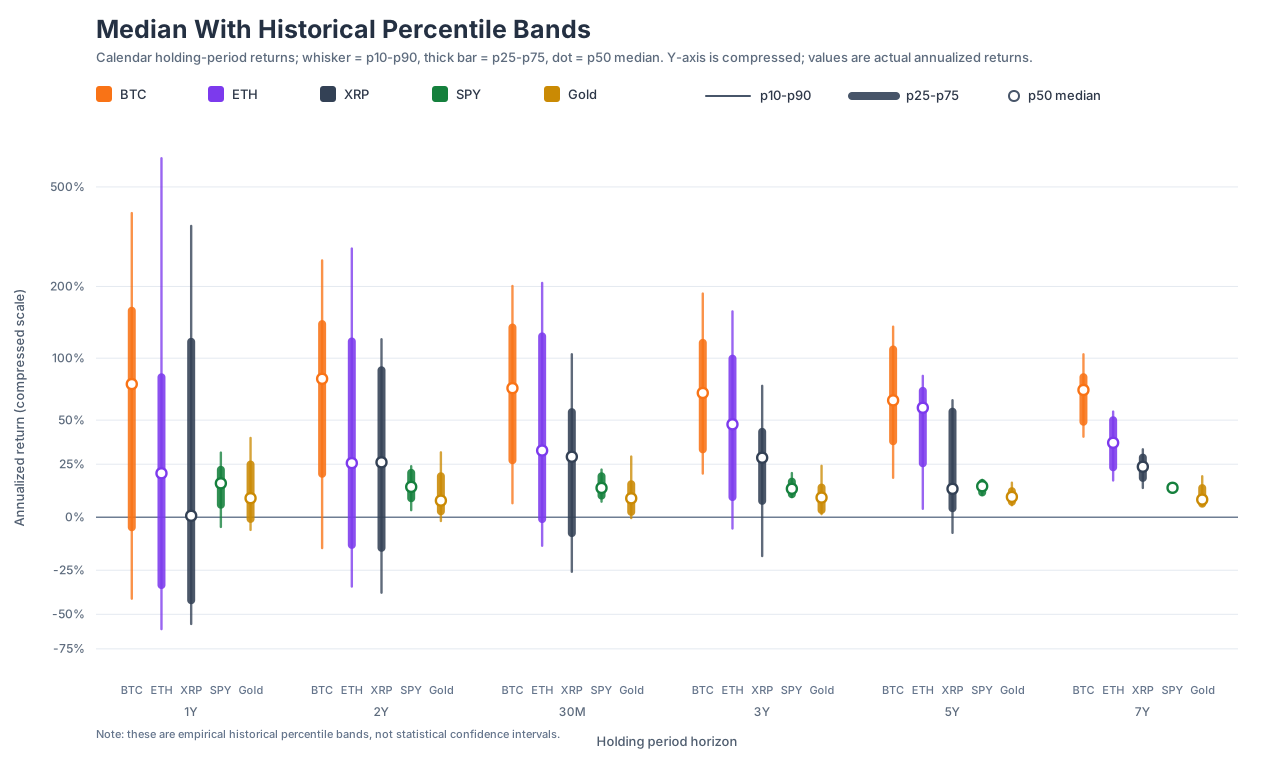
The dot is the median, the thick bar is the 25th to 75th percentile range, and the thin whisker is the 10th to 90th percentile range.
This makes the bullish case very obvious: historically, Bitcoin rewarded longer holding periods far more than the other assets in this sample.
But the median is not enough. For Bitcoin, the 1-year and 2-year pessimistic numbers are still scary. In the total sample, the 10th percentile 1-year BTC return was about -44%. The 10th percentile 2-year annualized return was about -24%.
That is exactly why I am not a maximalist. A person who may need the money soon should not pretend this is normal savings.
But the longer horizons look very different.
For 5-year windows, Bitcoin’s 10th percentile annualized return was about 15% in the total sample. SPY’s median 5-year annualized return was about 14%.
That is the bullish Bitcoin argument in one sentence:
Historically, Bitcoin’s bad 5-year outcomes were still competitive with normal stock-market outcomes.
But there is another trap here. Bitcoin’s 5-year sample is tiny compared with the U.S. stock market. We should not treat a few overlapping windows as if they were a century of independent evidence.
So I read this as supportive, not conclusive.
A portfolio is not a religion
This is where I think the portfolio analysis becomes more useful than the asset-only analysis.
If you look only at Bitcoin, you can easily end up in a silly debate:
Bitcoin is either the greatest asset ever created, or it is a speculative bubble.
But most people do not need that debate to be resolved. They need to decide whether Bitcoin should be 0%, 2%, 5%, 10%, or 50% of their portfolio.
So I tested simple annual-rebalanced portfolios where the BTC allocation is funded from SPY. For example, a 5% BTC allocation means 95% SPY and 5% BTC.
Over the full 2014 to June 2026 sample:
- 100% SPY turned $1 into about $4.44, with a Sharpe ratio around 0.81.
- 95% SPY / 5% BTC turned $1 into about $8.47, with a Sharpe ratio around 1.06.
- 80% SPY / 20% BTC turned $1 into about $27.86, with a Sharpe ratio around 1.23.
- 100% BTC turned $1 into about $131.23, but its Sharpe ratio was around 0.96 and its max drawdown was about -83%.
That last point matters.
The best total return was basically Bitcoin. No surprise there.
But the best risk-adjusted result was not 100% Bitcoin. In this sample, adding BTC improved the portfolio sharply at first, then the benefit started to flatten and reverse as volatility took over.
This is why I like the small allocation argument. You do not need to believe Bitcoin should replace your whole portfolio. You only need to believe that a small amount of asymmetric upside is worth tolerating.
Why 2% is easy to defend and 5% feels reasonable
My practical conclusion is that 2% BTC is easy to defend for a stock-heavy investor.
At 1% to 5%, the historical drawdown profile barely changes compared with 100% SPY, but the upside changes a lot. The 5% BTC portfolio had a similar maximum drawdown to SPY in this sample, but much higher total return and Sharpe.
That does not mean it is risk-free. Nothing here is free.
But the cost of being wrong at 2% is limited. The cost of being wrong at 50% is life-changing.
That is the whole point.
If you are in your 20s or 30s, expect to keep earning income, and are accumulating wealth over the next 20 or 30 years, you can probably tolerate more volatility than someone who is 60 and needs the money soon.
That is another hidden assumption in this article. I am writing mostly for accumulators, not retirees.
What about a little gold?
I also tested portfolios that include SPY, BTC, and gold.
The idea is pretty simple. SPY is the core growth engine. BTC is the high-upside volatile sleeve. Gold is the diversifier that still behaves differently from both.
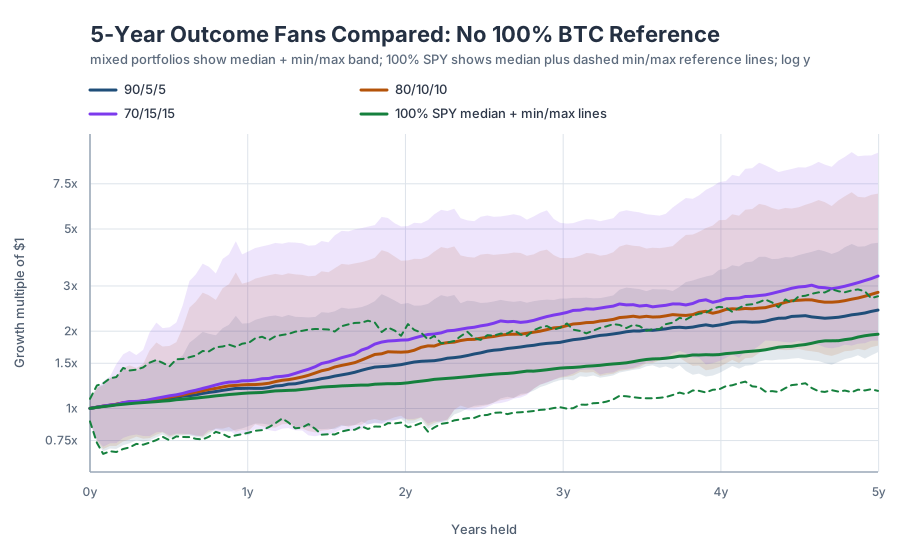
For 5-year rolling windows:
- 90% SPY / 5% BTC / 5% gold had a worst terminal outcome around 1.66x and a median around 2.42x.
- 80% SPY / 10% BTC / 10% gold had a worst terminal outcome around 1.76x and a median around 2.83x.
- 70% SPY / 15% BTC / 15% gold had a worst terminal outcome around 1.84x and a median around 3.28x.
That is very interesting.
It does not prove those portfolios will work in the future. But historically, small BTC plus some gold created portfolios that looked better than my intuition expected.
This is also where I want to be careful with words like “free upside.” The upside is not literally free. You are accepting model risk, Bitcoin-specific risk, and the risk that the future does not resemble the past.
But in the historical data, the first few percentage points of Bitcoin exposure did look surprisingly cheap.
So what do I actually believe?
I think it is mostly unreasonable to own 0 BTC if you are a stock-heavy accumulator with a long horizon. Looking at the data, owning a little bit of BTC makes more sense to me than owning none.
I also think anything more than 30% Bitcoin is usually unreasonable.
The interesting range is between those two extremes.
My current view is:
- 2% BTC is easy to justify for a stock-heavy investor with a long horizon.
- 5% BTC is my preferred default for someone who is bullish but still sane.
- 10% to 20% BTC can be justified by the historical data, but you need to accept that your portfolio will start behaving differently.
- Above 30%, you are no longer adding Bitcoin to a portfolio. You are building a Bitcoin portfolio with some stocks attached.
The boring answer is probably the right one:
Bitcoin is not a religion. It is also not a toy.
Bitcoin is a volatile, historically high-return asset with a real but uncertain value proposition. That makes it worth owning carefully, not worshiping.
Let me know what other analysis you would like to see. I am especially interested in adding withdrawal scenarios, contribution profiles, CPI-adjusted returns, and a comparison with individual stock picking to test how much of the Bitcoin story is just survival bias.
Finance glossary
SPY: An ETF that tracks the S&P 500. I use it as a proxy for a broad U.S. stock portfolio.
BTC: Bitcoin.
SGOL: A gold ETF. I use it as a practical gold proxy because it has accessible Yahoo Finance data.
Allocation: The percentage of a portfolio invested in each asset. For example, 95% SPY / 5% BTC.
Drawdown: The fall from a previous portfolio high to a later low. A -50% drawdown means a portfolio was cut in half from its peak.
Rolling return: The return over many overlapping historical windows. For example, every possible 5-year period in the data.
Percentile: A way to look at the distribution of outcomes. The 10th percentile means 10% of historical windows were worse and 90% were better.
Sharpe ratio: A rough measure of return per unit of volatility. Higher is generally better, but it is not magic and it can hide important risks.
Correlation: A measure of how assets move together. High positive correlation means they usually move in the same direction. Low or negative correlation can help diversification.
Conditional return matrix: A table that groups one asset into return buckets, then shows how other assets performed during those same periods. It is useful because it shows the pattern across good, bad, and normal markets instead of compressing everything into one correlation number.
Nominal returns: Returns before adjusting for inflation.
Real returns: Returns after adjusting for inflation. This first version uses nominal returns only.
Methodology and reproduction notes
This is an exploratory analysis, not financial advice.
The data comes from Yahoo Finance adjusted-close price history. I used BTC-USD, SPY, ETH-USD, XRP-USD, and SGOL. The main BTC/SPY/gold sample starts on 2014-09-17 and runs through 2026-06-26. The five-asset crypto sample starts later because ETH and XRP have shorter Yahoo histories.
The portfolio tests assume:
- Annual calendar-year rebalancing.
- Pure accumulation, with no contributions or withdrawals.
- Starting wealth of $1.
- BTC allocation funded from SPY.
- Zero risk-free rate for the basic nominal Sharpe ratio.
- No fees, taxes, slippage, spreads, or custody risk.
- Nominal returns only.
To reproduce the current run:
python3 download_btc_yahoo.py --ticker BTC-USD
python3 download_btc_yahoo.py --ticker SPY
python3 download_btc_yahoo.py --ticker ETH-USD
python3 download_btc_yahoo.py --ticker XRP-USD
python3 download_btc_yahoo.py --ticker SGOL
python3 -m src.mvp_concentration
The script writes CSV, Markdown, and SVG outputs under outputs/.
The most important generated files are:
mvp_report.mdfor the summary report.mvp_concentration_table.csvfor SPY/BTC allocation results.mvp_horizon_percentiles.csvfor rolling return percentile data.mvp_pair_correlations.csvfor same-window rank correlations.mvp_conditional_returns.csvfor monthly conditional return matrices.mvp_mixed_portfolio_sharpe.csvfor mixed portfolio Sharpe comparisons.mvp_fan_5y.csvfor 5-year fan chart data.
The main limitation is sample size. Bitcoin has only existed for a short time, and many of the rolling windows overlap. That means the charts are useful for intuition, but they should not be read as a guarantee.
The next things I would like to add are CPI-adjusted returns, cash/T-bill data for excess-return Sharpe, contribution scenarios, withdrawal scenarios, and stress tests for fees, taxes, and rebalancing frequency.
Backwards-compatible chart
This is the legacy-style chart from the older article methodology. I am keeping it here mostly for comparison with the original analysis.